Before Ashmoor has a player, a controller, or a single line of game logic, it has a scene whose only job is to answer one question: does the moor read?
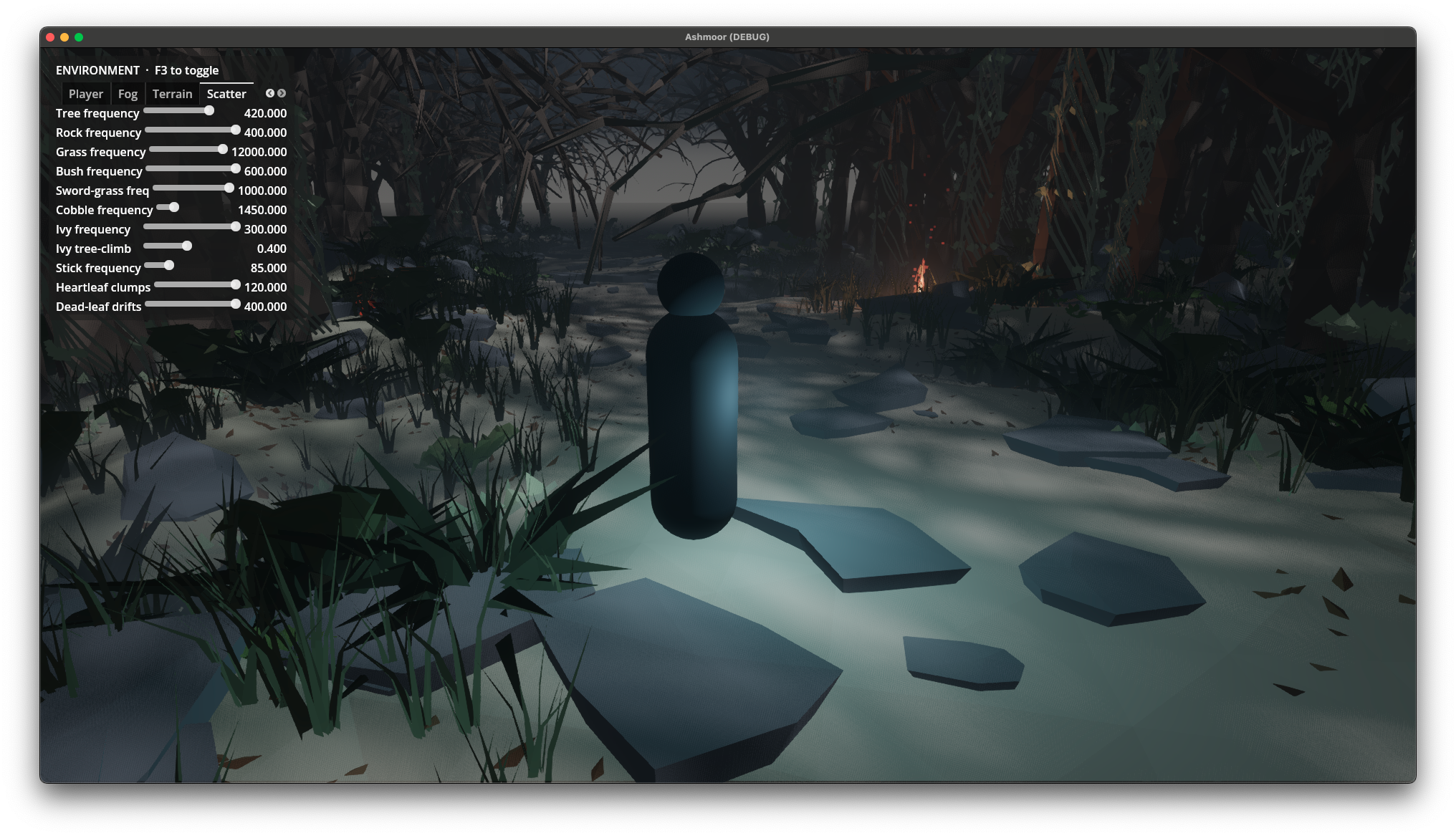
A test scene this early is really a contract with the thing being built. Ashmoor's contract is that the world is the antagonist, the witness, and the proof. Before any of that can be true, the moor has to read at a glance. Faceted trees and a capsule body are enough to start asking the question.
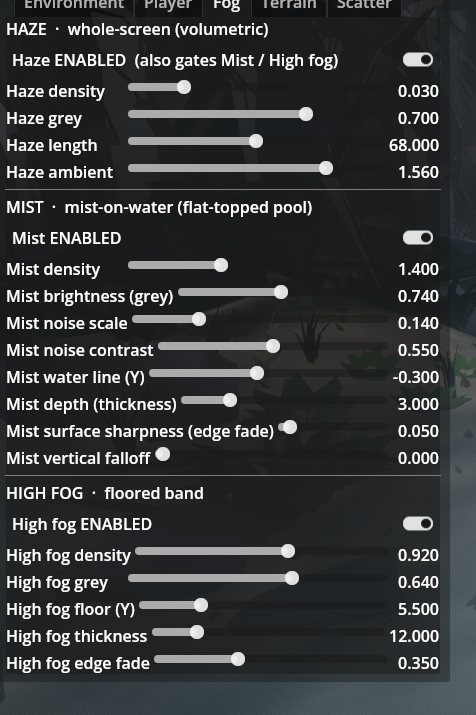
Every visual variable that matters in Ashmoor lives on a slider. The atmosphere is tunable in real time so it can be adjusted to what each scene needs rather than fixed once and never touched. The look-dev flat state, with neutral light and fog off, is the master baseline. Every other state in the project gets measured against it.
Adding fog
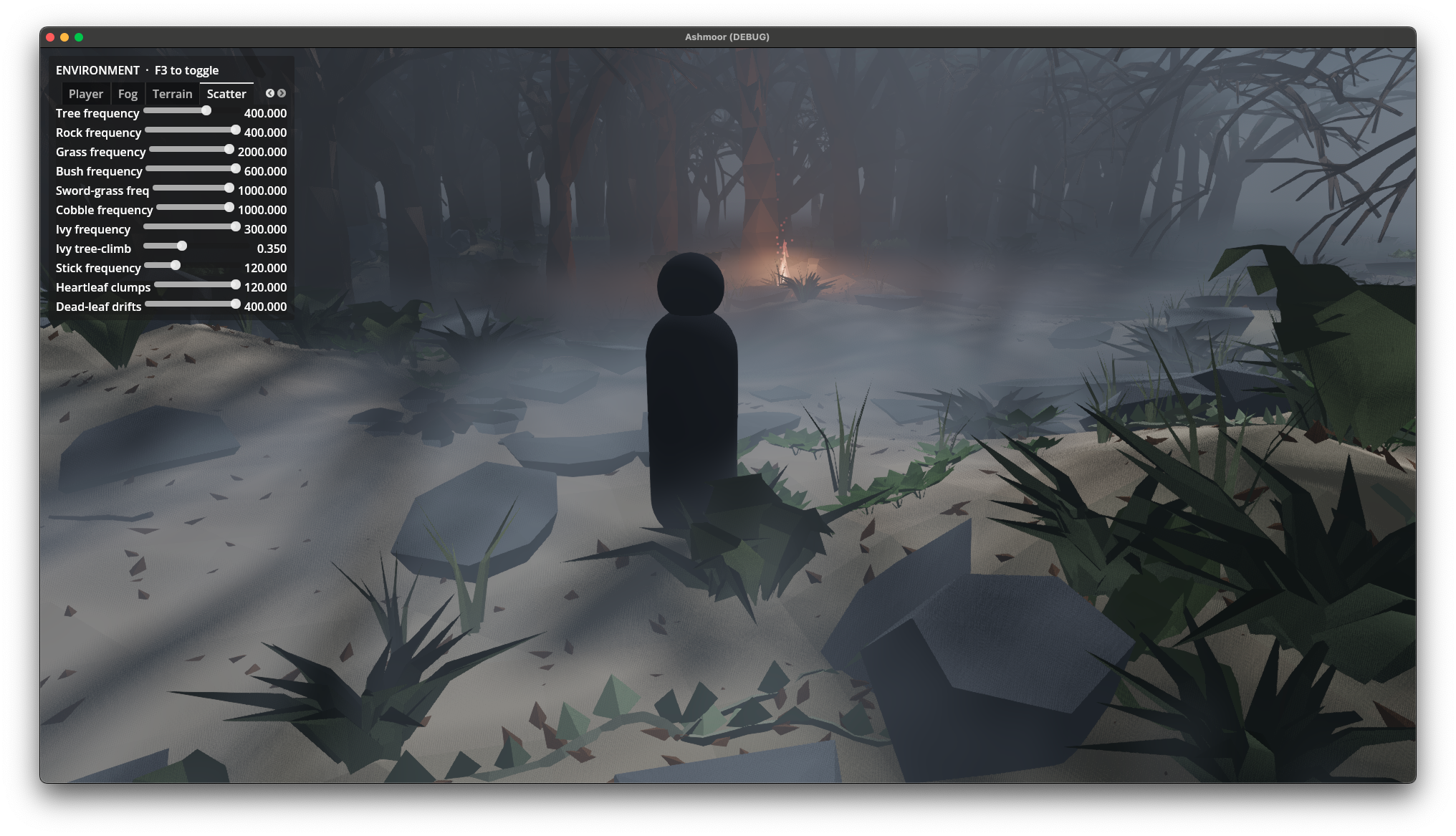
Fog is the first atmosphere layer because Ashmoor's whole proposition depends on it. The world has to feel like it's withholding something. Not because the designer is hiding things, though there are things to hide, but because what's out there is the game's only real question, and the answer has to feel unreachable at every distance. Fog is the medium that question lives in. If the fog reads wrong, nothing reads.
Even at modest density the scene gains depth. The far trees recede instead of all sitting in the same plane. This is the layer that, when it works, you stop noticing.
Adding mist
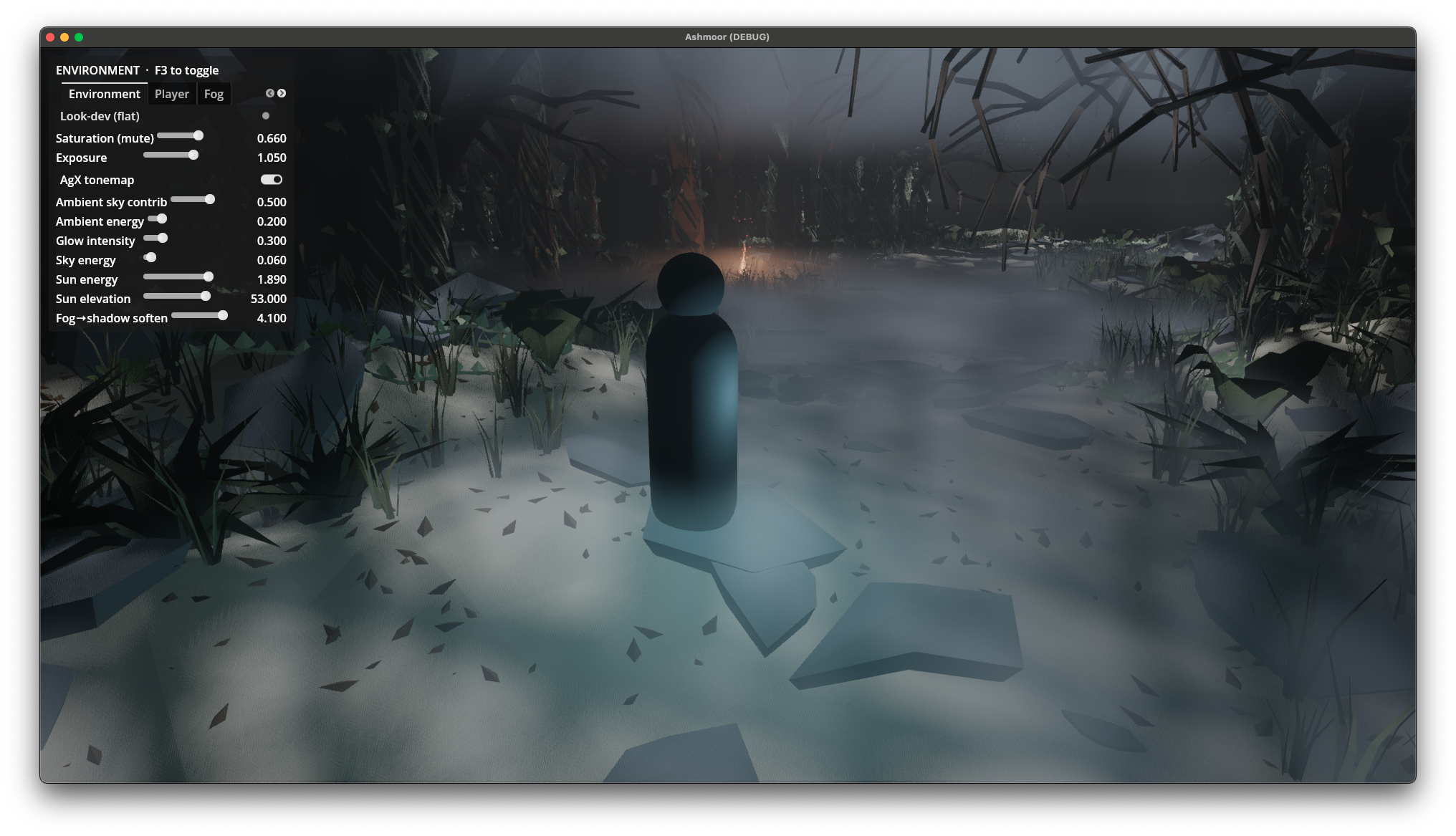
Mist is the ankle-deep ground pool. It's the layer that makes the moor feel damp. The surface holds a noise contrast so it doesn't read as a smooth disc, and a quiet drift on the height moves it just slowly enough that you don't see the motion. You only see that the world isn't static.
This matters more than it looks like it should. A world that doesn't move at this scale tells the player they're alone inside a diorama. A world that moves too much tells them something's about to happen. The mist drift sits in the bandwidth between those two readings, at a frequency of life so low it just barely registers. That's what the moor needs to feel like.
Day and night, same scene
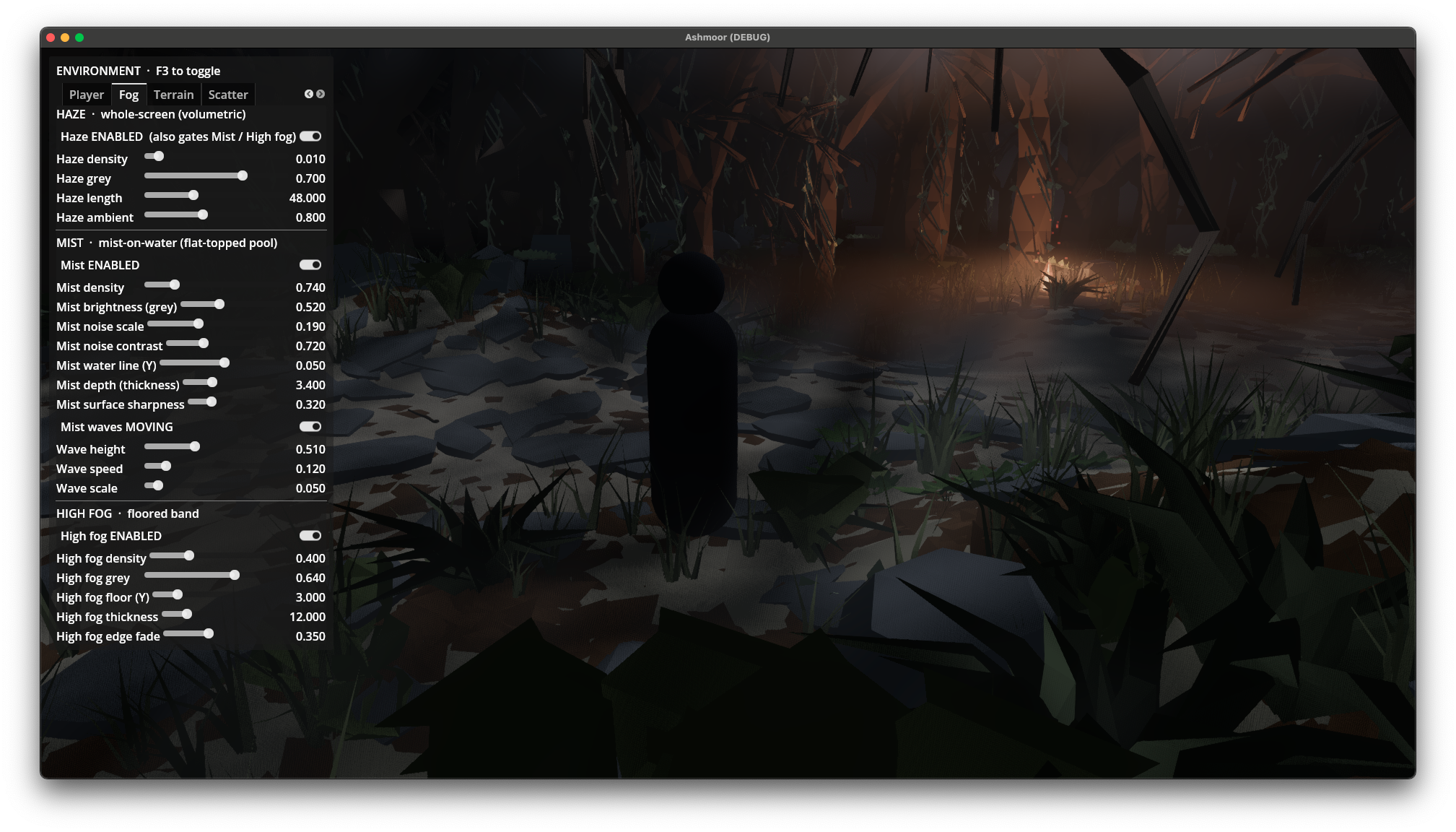
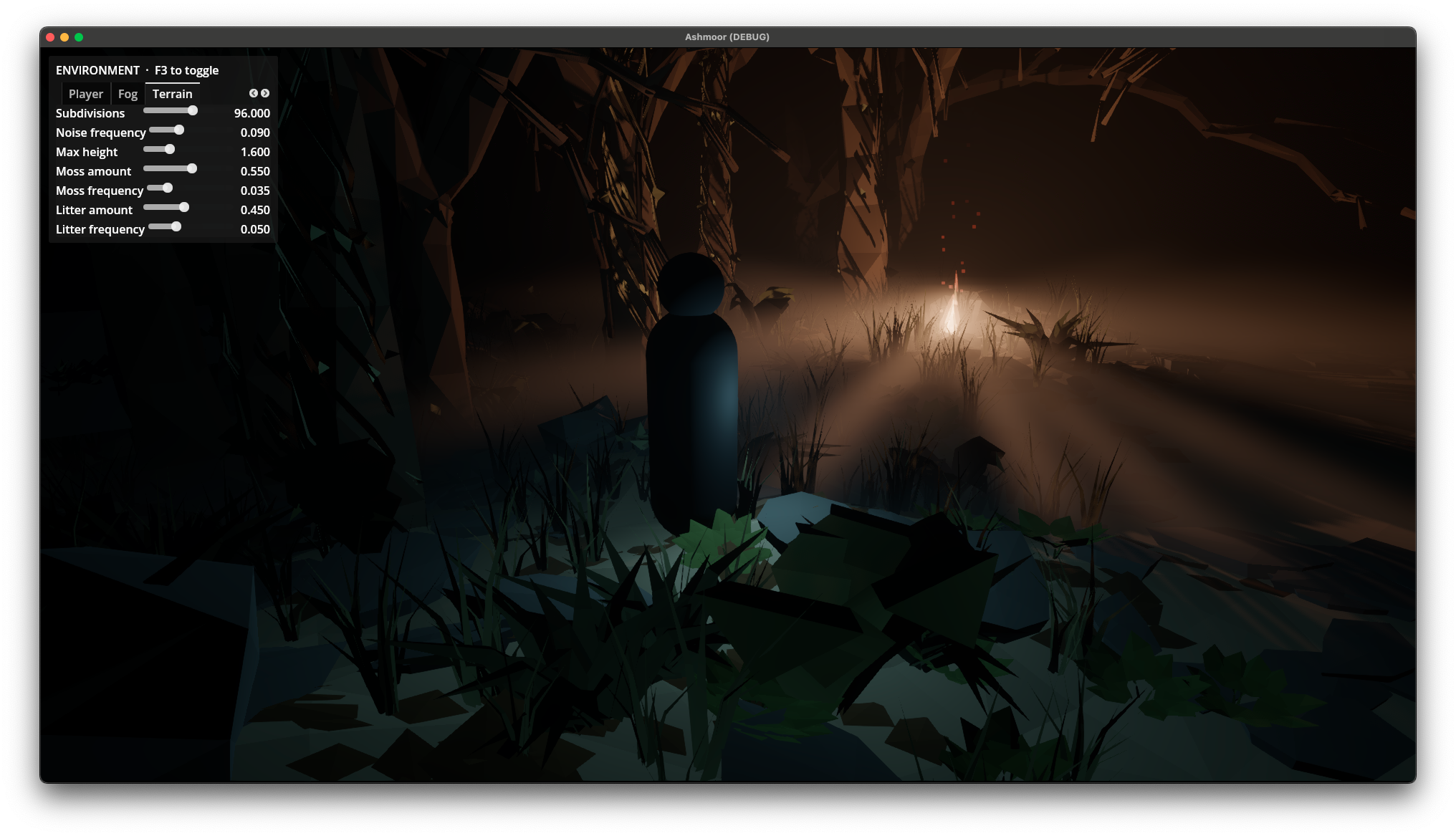
The same scene, two times of day. Daylight is honest. It shows every faceting mistake. The moor lives at dusk and after. The night frame above is the moment the project clicked. One warm point in the distance, the rest dark and quiet. That's the silhouette Ashmoor is built around.
There's a thematic reason for that, separate from any aesthetic one. The day loop in Ashmoor is exploration, scavenging, investigation. Things the player believes they understand. The night is something else. The night is when the world stops being a place you're in and starts being a place that knows you're in it. If a single distant warm point can read as the only thing keeping you alive, the rest of the design has a foundation.